
 |


The University of Guelph in Ontario, Canada is a long-standing user of Maplesoft products such as Maple, a technical computing and documentation tool, and Maple T.A., an online testing and assessment solution. Recently, faculty and staff at the University of Guelph embarked upon an experiment to statistically determine the impact on students of using Maple T.A.
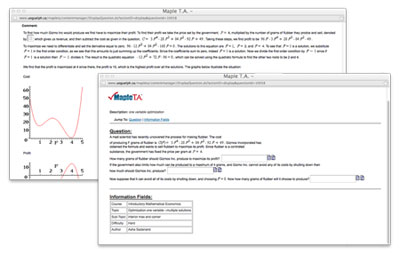
An undergraduate Mathematical Economics class was chosen for the study, with one half of the students being randomly assigned to use Maple T.A., and the other half to use conventional tools. The final grade for all students were split as follows: 30% from their midterm, 50% from the finals and the remaining 20% from assignments and quizzes using Maple T.A. or other tools depending on the group the student was in. Apart from analysing the final exam scores, a survey was also conducted to determine the students’ qualitative impressions, preferences and attitudes.
The students’ preference for the Maple T.A. group was evidenced by the majority of the group preferring to stay in their assigned group, while half of the conventional group wishing to be assigned to the Maple T.A. group.
More significantly, results showed a lower drop-out rate in the Maple T.A. group (9%), with the students that dropped being the ones that had the lowest GPA scores. However, in the conventional group the drop rate was higher (20%), and students with a spectrum of GPA scores dropped the course. “The lower drop-out rate and the quality of the students who dropped out indicate that students who used the Maple T.A. tests and assignments had a better understanding and grasp of the subject than the other students,” said Dr. Asha Sadanand, Full Professor in the Department of Economics and Finance, University of Guelph. “More students in the Maple T.A. group said they liked the course compared to the conventional group. To me, this shows a boost in the students’ confidence levels through the use of tools like Maple T.A. which let students learn at their own pace and time.”
Maple T.A. is an easy-to-use web-based system for creating tests and assignments, and automatically assessing student responses and performance. Because Maple T.A. is powered by Maple, it offers features especially suited for assessment in technical courses. Through Maple T.A., students get an opportunity to practice questions they would normally be left to do completely on their own, and are given instant feedback to show them how to improve.
“Besides being an excellent learning tool for students, Maple T.A. is a wonderful aid for teachers too,” continued Dr. Sadanand. “We saved significant amounts of time in marking tests and assignments, freeing instructors’ and Teaching Assistants’ time to do more productive work. We can now offer more tutorials, small group interactions and even provide more personal attention to students, which was limited due to time constraints. The technology in Maple T.A. also helps us to delve deeper into the students’ thought processes and see how they approach their problems and assignments.”
Powerful, algorithmically-generated questions in Maple T.A. turn one question template into hundreds or thousands of similar questions, providing individual homework assignments and lots of practice questions for students. “This is one of Maple T.A.’s biggest strengths,” commented Dr. Sadanand. “It is a time-saver and an extremely useful tool for students and teachers.”
Encouraged by the results she found, Dr. Sadanand and her team at the University of Guelph are planning to roll out Maple T.A. to new programs and courses.
 Contact Maplesoft to learn how Maple can be used for your projects
|
Produits | Solutions | Achetez | Support Technique | Ressources | Société | Maplesoft | Carte du site | Login
|
 |
||
© Maplesoft, une division de Waterloo Maple
Inc. 2016.| Terms of Use | Confidentialité | Marques déposées MATLAB, Simulink, and Simulink Coder are trademarks or registered trademarks of The MathWorks, Inc. |
|||





