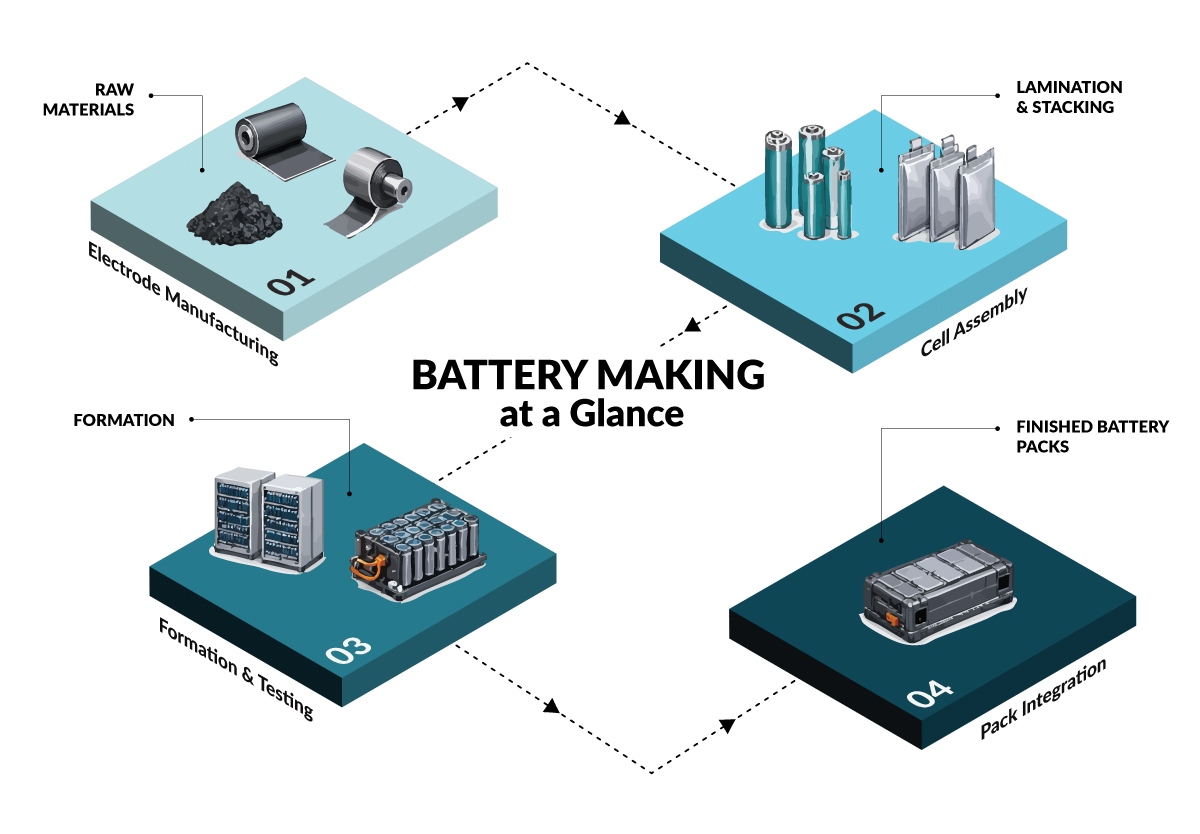
Jelly roll winding is where battery manufacturing's most expensive materials meet its most demanding precision requirements. At a 10-gigawatt facility, web handling failures at this single process stage cost an estimated $49 million annually during new product introduction. The root causes (interacting tension, alignment, roller, and speed dynamics) are well understood. What has been missing is a practical method for resolving them that doesn't depend on costly physical experimentation on live production equipment.
MapleSim for Web Converting Systems is that method: a physics-based, system-level simulation platform that enables battery manufacturers and machine builders to model, predict, and optimize winding dynamics before hardware is adjusted or material is consumed.
The cylindrical lithium-ion battery cell - the kind powering the EV sitting in your driveway- is, at its core, a precision roll-to-roll converting product. The jelly roll - the tightly wound assembly of anode, cathode, and a separator that forms the functional part of the cell is manufactured on winding equipment governed by the same fundamental physics that define any web handling system: tension, alignment, roller dynamics, and speed control.
What distinguishes battery electrode winding from convention roll-to-roll processes is not the physics but the stakes. The substrate is among the most fragile in industrial manufacturing: so fragile that web breaks are not an occasional nuisance but a routine and costly production event. The material cost per unit area is among the highest. The precision tolerance, tension variations exceed those of virtually any comparable converting application. And the consequences of getting it wrong extend beyond scrap yield.
The gigafactory build-out of the past decade has brought significant engineering investment to this problem. Many North American and European Gigafactories run winding equipment imported from Asia- machine operated in their home facilities by technicians with thousands of hours of hands-on experience tweaking parameters and reading the line. That accumulated knowledge doesn't transfer with the equipment. When the machine arrives, the institutional know-how stays behind, and facilities are left to discover optimal operating conditions from scratch, on expensive material, at production cost.
Yet even with that investment, scrap rates at the winding stage remain high across the industry, NPI (new product introduction) timelines remain long, and physical experimentation on live production equipment remains the dominant and most costly troubleshooting method.
Battery electrode foil carries a concentration of value per unit area that has no close parallel in conventional converting. Cathode active material represents approximately 45% of a finished cells' cost, anode a further 13%. Together, the two-electrode web account for more than 58% of the cell value. When a jelly roll is scrapped due to a winding defect, that value is lost entirely - there is no rework path, no partial recovery.
At a 10-gigawatt facility, scrap rates during NPI routinely reach 20-30%, generating approximately $49 million in annual waste from the winding stage alone. At steady state, even best-in-class operations absorb $15.7 million per year. Each percentage point reduction in scrap rate recovers approximately $4.9 million annually. Machine downtime during troubleshooting adds $15,000-$30,000 per hour on top of direct material losses.
At a 10-gigawatt battery manufacturing facility, the financial impact of winding-stage scrap is as follows:
| Production Phase | Annual Waste Cost (10 GWh facility) |
| New Product Introduction (NPI) | $49 million |
| Pre-production | $29 million |
| Steady-state (best-in-class) | $15.7 million |
Jelly roll winding failures rarely have a single root cause. They arise from four coupled dynamic failure modes that are difficult to isolate and control independently.
The central challenge is not any single failure mode but their interaction. Tension variation influences alignment. Roller dynamics affect tension. Speed transients upset both. This interdependence is precisely why physical trial-and-error is so poorly suited to diagnosing and resolving winding problems.
Most battery manufacturers and machine builders approach winding problems the same way: adjust a parameter, run the line, inspect the output. It is a reasonable instinct and an expensive one. Physical trial-and-error consumes the same high-value electrode material driving the waste cost. And because jelly roll defects are driven by interacting variables, isolating a root cause through single-variable adjustment rarely converges quickly. NPI timelines stretch to one to two years not from lack of engineering skill, but because learning on expensive material without the benefit of the machine operators who spent years mastering it at the source, has no shortcut.
The gap no empirical method fills is predictive capability - knowing how the system will behave before the line is run. That is what MapleSim for Web Converting Systems provides.
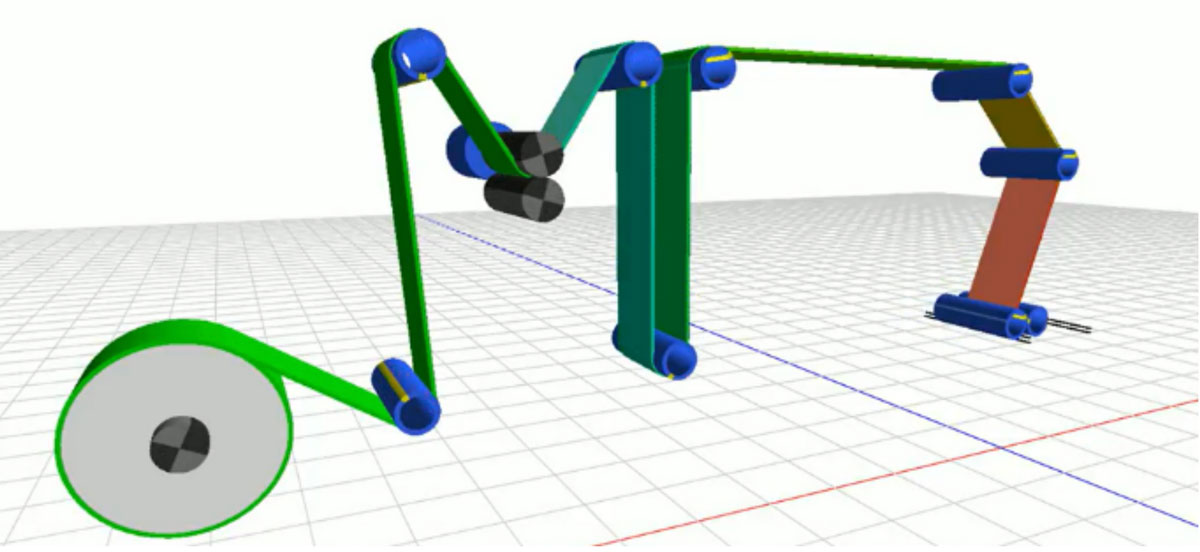
Simulation Scope: Simulation tools operate at three distinct levels: plant-level for throughput and logistics, part-level for thermal and structural analysis, and system-level for dynamic system behavior. MapleSim for Web Converting Systems occupies the machine level - the scope at which tension dynamics, roller interactions, dancer behavior, motor response, and control system performance are modelled as a coupled system. This is where jelly roll winding failure modes originate, and where effective intervention must be applied.
Technical Foundation: MapleSim's symbolic math engine derives optimized system equations directly from component-level physical models, accurately representing behavior across transient operating conditions not just at steady state. The platform is multi-domain, integrating mechanical, electrical, hydraulic, and control system dynamics within a single environment. The governing equations from the Web Handling Handbook - the field's primary technical reference are implemented directly within the framework.
Engineering Capabilities: MapleSim for Web Converting Systems provides tension control optimization across winder and unwinder configurations, multi-layer winding simulation, dancer and accumulator design evaluation, roller dynamics and slippage analysis, motor and actuator sizing, and direct integration with control code for validation before hardware deployment.
The Virtual Testing Workflow: A validated model of the winding line is built from component-level physical parameters, then used to run what-if scenarios physics-based prediction of outcomes. Root cause hypotheses are tested and eliminated virtually. Design options are evaluated before hardware is procured. Control strategies are validated before deployment. Engineering decisions that previously required physical trials are made in the simulation environment, before the machine is touched. .
Challenge: A large battery manufacturer needed to validate a buffer system design for a complex section of the electrode winding line - multiple rollers and an accumulator stage before committing to hardware.
Solution: Maplesoft built and validated a MapleSim model of the web line section, then used it to evaluate roller sizing and buffer configuration options virtually. Optimal design parameters were identified through simulation, hardware procurement proceeded against a validated specification, and weeks of physical trial time and line downtime were eliminated.
Challenge: A large U.S. battery manufacturer was experiencing persistent tension fluctuations in a production winding line, generating defects and resisting resolution through conventional troubleshooting.
Solution: Maplesoft constructed a full dynamic model of the winding line in MapleSim and used it to evaluate candidate root causes virtually, running in simulation the tests that would otherwise have required machine downtime and material consumption. Simulation identified the root cause, a targeted web line modification was implemented, and the fluctuations were fully resolved. The validated model was retained for ongoing process optimization.
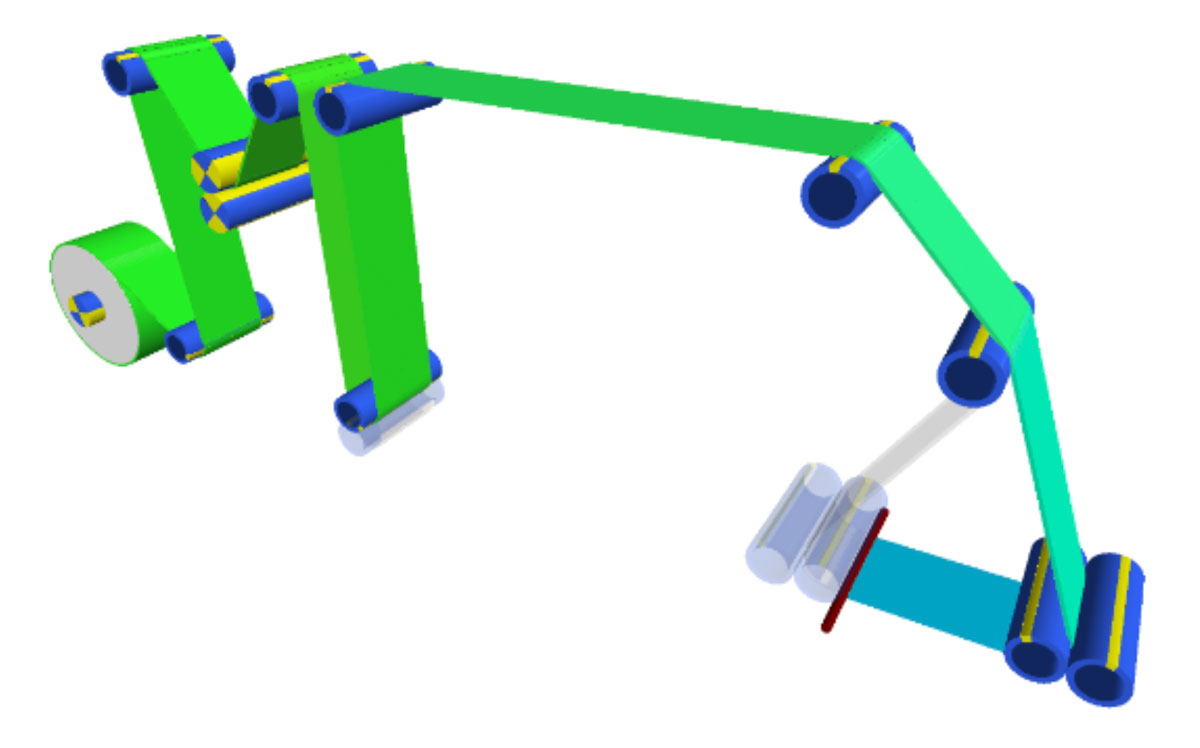
Challenge: A production machine manufacturer designing a new Z-fold battery assembly line needed to validate roller placement, dancer configuration, and motor sizing before parts were ordered.
Solution: MapleSim was used from the initial concept stage to evaluate and refine design options, perform motor and actuator sizing from simulated load profiles, and validate the full design before fabrication began. The manufacturer entered the build phase with validated parameters rather than first-iteration estimates, substantially reducing physical design iteration during build.
For a 10-gigawatt facility, MapleSim for Web Converting Systems delivers a 15-25% reduction in jelly roll assembly waste and a 20% reduction in physical testing time for new winding configurations. During NPI, that translates to $7.35M-$12.25M in annual savings. At steady state, minimum savings reach $2.36M per year from this phase alone.
Total implementation investment runs $100,000-$300,000 with no hardware requirement. Time to first actionable insights is within one week of deployment, with full implementation completed in three to five months.
Jelly roll winding is a web handling problem. The failure modes are well understood, the physics are well characterized, and the governing equations are established. What has been missing is a practical method for solving it that does not depend on expensive physical experimentation on high-value production equipment.
MapleSim for Web Converting Systems provides that method - shifting the engineering workflow from reactive troubleshooting to predictive optimisation. For battery manufacturers and machine builders facing the persistent cost of winding-stage waste, the tools are available. The question is how quickly they are put to use.
Download the PDF of this whitepaper
Cited References
Sources & Methodology
The analysis draws on a broader body of published research spanning battery manufacturing economics, electrode materials, scrap and recycling markets, and roll-to-roll processing — including peer-reviewed journals, industry reports, and analyst publications from organisations including Roland Berger, McKinsey, S&P Global, BCG, Nature, and ScienceDirect. Financial figures are based on Maplesoft internal scenario modelling.